

AI talent war pushes US firms to Asia’s outsourced coders
HIRING an artificial intelligence (AI) engineer is proving to be tricky for US executives of firms outside of Big Tech. Many are promising flexible setups and purposeful work, while others are leaning into a tried and tested strategy: outsourcing.
With tech salaries climbing and AI specialists scarce, more US enterprises are looking to outsource teams from South-east Asia and India for their tech development needs. According to a Deloitte survey, over 70 per cent of US organisations are outsourcing their software development and innovative tech needs, which include AI.
Specialised software developers and computer programmers in these Asian markets that have long served US enterprises are transitioning to become AI-focused tech teams for hire. Some are also developing their own suite of AI enterprise software.
Take for instance, First Mate Technologies, a Philippines-based firm that has served more than 30 startups in the US. It has helped clients build the first version of a product or launch a new feature.
“We come in, we build a product, and with our work, the startup can attract a CTO,” said First Mate CEO Hiro Yamada. “That formula has happened more than once, and it helped our clients raise funding.”
Yamada adds that his company’s client base has doubled over the past year.
BT in your inbox
Start and end each day with the latest news stories and analyses delivered straight to your inbox.
First Mate is not the only one serving US enterprises’ AI needs. From Mumbai to Manila, firms have emerged to aid in a wide range of projects, from simple product development to becoming de facto in-house engineering teams.
Asia’s cost-effective promise
Like the business process outsourcing industry, contracting tech teams for hire in Asia has emerged due to their cost efficiency.
These firms offer 50 to 70 per cent cheaper talent costs compared to hiring full AI engineering teams in the US, according to software development firms in the Philippines and Vietnam interviewed by Tech in Asia.
SEE ALSO

Data from Ziprecruiter shows entry-level AI engineers in the US take home an average of US$69,000 a year.
In Vietnam, the same role pays between US$17,800 to US$28,600 a year. In the Philippines, it is even cheaper at an average of US$14,000 a year, data from Indeed shows.
ProudCloud, a Manila-based software development boutique firm, assigns a team of six full-stack developers to serve one client. Each team has a product owner, a project manager, and four engineers.
Vietnam-based CX Genie and Rabiloo, both of which offer customised AI solutions, also dedicate teams when taking on projects. Others, such as First Mate assign one or two developers per client.
While such a setup means outsourcing multiple talents, these firms insist they are still far cheaper than a single full-time hire in the US.
Flexible work setups
Their work contracts have also been flexible. First Mate and ProudCloud typically sign six- to 12-month contracts with clients, which are enough for their teams to complete one product until its launch.
“These are startups who have founders that realised they would rather focus on product-market fit than managing their own development teams,” said ProudCloud CEO Jay Fajardo.
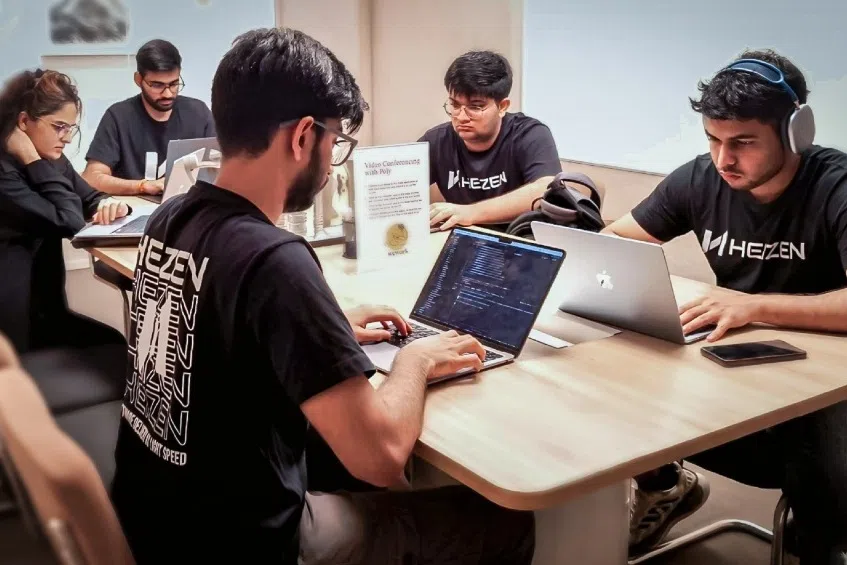
For outsourced firms that target SMEs, which may initially only be seeking an AI solution for specific operational problems, a flexible payment setup allows them to build rapport with clients.
“For these companies, they need to see the value of AI for themselves before investing further. So we only charge them weekly,” said Nijansh Verma, co-founder of India-based enterprise AI solutions provider Heizen. “That way, they know we are fulfilling a specific need.”
Heizen, which also has an office in San Francisco, relies on AI agents to help deploy their services. These agents assist on every step of product development, from data analysis to product design.
Each of its 30 software engineers can tap these agents to help deliver a client’s request. According to Verma, this allows Heizen to price its services “competitively”, and he estimates that the firm is 80 per cent cheaper than what a consulting firm such as Infosys may charge, though he did not name specific values.
More than cost savings
Increasingly, enterprises are focusing on the “value-added” services these outsourced firms provide, more than their cost benefits.
The Deloitte 2024 survey mentioned earlier found that the top reasons for outsourcing are “improved access to talent” and “increasing customer demands.” Only 34 per cent of firms cited cost reduction, down from 70 per cent in 2020.
Take Rabiloo, a Hanoi-based software development company. After it developed a genAI-enabled chatbot for its clients in Vietnam, Japan, and Europe, many of them availed of its services to develop customised AI products.
Rabiloo cites how some retail industry clients in Japan asked for an AI-enabled image and data processing tool for footage captured by store cameras for ad purposes.
“Most of the time, companies are unsure how to incorporate AI into their operations,” said Kien Ta Trung, vice-president at Rabiloo. “So we are there to help them figure that out.”
Fellow Vietnamese firm CX Genie takes a similar approach. It offers a subscription for its genAI-enabled customer service software. While the subscription-based product is affordable, more clients are seeking a customised chatbot tailored to their brand’s identity, its CEO Ethan Nguyen said.
He adds that these customised solutions have been mainly tapped by firms in the Middle East and Taiwan, while its subscription-based product is used by global companies.
Trust is critical
Consistent to the experience of these outsourced firms is the value they place on building customer relationships. At a time when the AI industry makes sweeping promises, network-building is critical for solution providers.
Dexter Ligot-Gordon, co-founder and CEO of Manila-based Swarm, knows this all too well. He established a B2B marketplace for genAI teams and enterprises.
“In this business, trust is the most important thing,” he said. “These projects and teams became part of Swarm’s network because they referred a talent whom they can trust to do the project.”
The marketplace, now with 40 teams with almost 3,000 members, began with Ligot-Gordon’s and Swarm co-founder Alex Collado’s own networks of software developers. Through its platform, companies – including Samsung and Hugging Face – can find teams that can fulfil their project needs.
One may ask: can’t enterprises hire engineers directly? Players interviewed for this story believe most clients still seek a “trusted source” to cut through all the noise.
Likewise, it’s tempting for developers of these enterprises to seek international clients themselves. But with the volatile job market in the US, it’s a risk that many do not take.
“Access to high-calibre talent is still difficult to reach with all the noise in the market,” First Mate’s Yamada said. “You would still want to hire a tried-and-tested firm.” TECH IN ASIA
