Caraway’s $495 coffee maker is designed to keep plastic out of your morning cup of joe
Caraway spent years designing pretty pans without the toxic coatings. Next, it’s coming for the coffee maker. The brand’s first appliance, which launches today for $495 online and at Crate & Barrel stores, took five years and 10 pending patents. The result is a sleek 10-cup coffee maker that,…
Caraway spent years designing pretty pans without the toxic coatings. Next, it’s coming for the coffee maker.
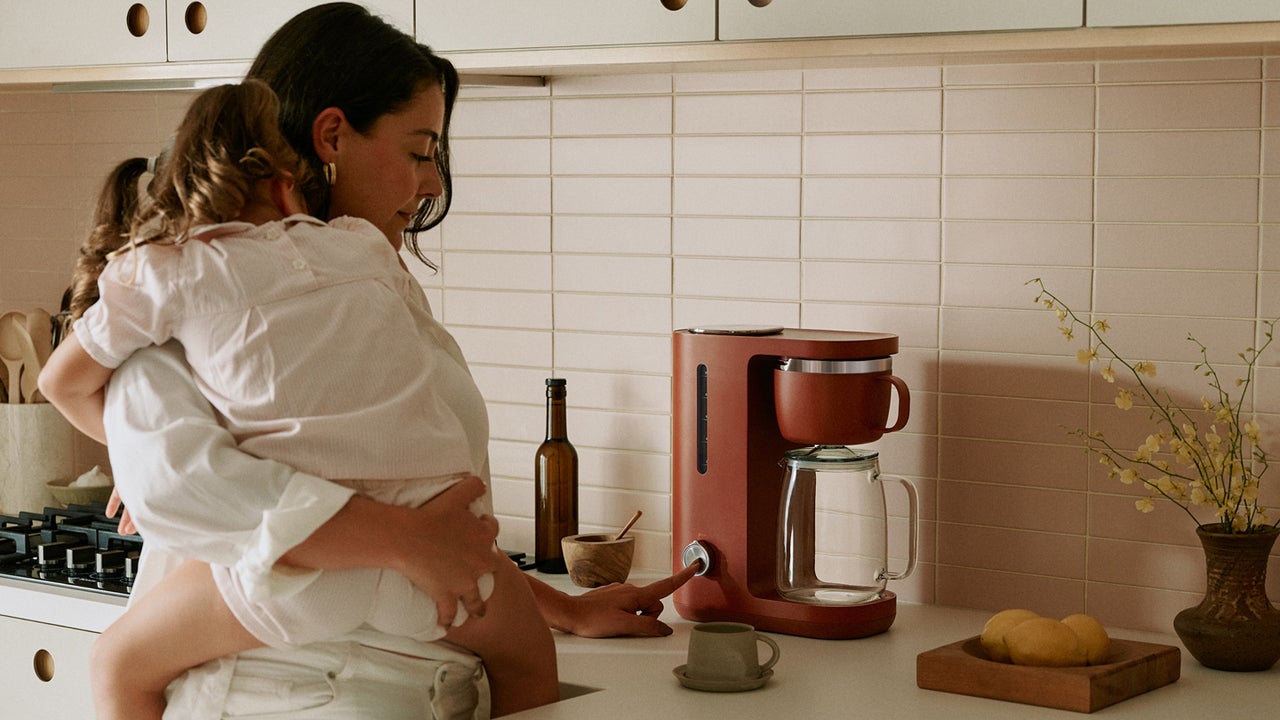
The brand’s first appliance, which launches today for $495 online and at Crate & Barrel stores, took five years and 10 pending patents. The result is a sleek 10-cup coffee maker that, unlike almost every competitor on the market, has zero plastic components in its brew path.
For Caraway, this product is the continuation of a broader goal. The company was founded in 2019 by Jordan Nathan after he experienced “Teflon flu,” a condition caused by inhaling fumes from burning polymer products; in Nathan’s case, a nonstick pan. His first product was a line of Teflon-free ceramic pots and pans with delightfully color-coordinated exteriors. Since then, the Caraway CEO has expanded the brand’s wares into knives, cutting boards, trash cans, and more.

“Our mission is really simple: to create the first generation of nontoxic homes,” Nathan says.
Caraway’s thesis is that there’s a consumer niche out there that’s willing to invest more in their home goods for both health-conscious and aesthetically pleasing design. So far, that’s proven true. The company has accumulated more than 2.5 million customers, raised $40 million over several rounds of financing, and is available via its own direct-to-consumer site and partners like Target, Crate & Barrel, Walmart, Amazon, and Costco.
But Nathan isn’t slowing down. He’s planning to build out an entire ecosystem of Caraway-branded home products that will set the brand up for the next “100 years”—and he’s starting with his least favorite appliance. “Ever since I started Caraway, the coffee maker has always been the most offensive item in the kitchen from a design perspective,” Nathan says. He thinks he’s built the solution.
Engineering a healthier coffee maker
Take a look inside the coffee maker on your kitchen counter, and chances are good that you’ll find plastic, plastic, plastic.
“All coffee makers have plastic in some way, shape, or form entering the brew path—whether it’s the tubing or the brew basket or the actual carafe,” Nathan says.
The issue with that is fairly straightforward: Plastic degrades into microplastics, and that degradation is worsened by heat. Every time hot water runs through the plastic pieces of a standard coffee maker, chances are good that some microplastics are ending up in your morning joe. (We’re already breathing and eating enough microplastics that scientists have found the weight equivalent of an entire plastic spoon in human brains.)
But finding a good alternative is no simple task. Nathan says he scoured the market and found very little overall innovation, especially when it came to eliminating plastic (an ex-SpaceX engineer only just unveiled a plastic-free pot this March).
When Nathan started ideating his own nontoxic coffee maker, he discovered that the necessary parts didn’t even exist on the market. So, he spent several years custom engineering the necessary components from the ground up, including stainless steel internal tubing, a steel brew basket, a glass water reservoir and carafe, and metal housing. The design had to eliminate plastic in the brew path, make “a great cup of coffee,” and look good—a combination that took 200 iterations to perfect.
Once the design and prototype were complete, Nathan’s challenges were just beginning. He recalls bringing the concept to two dozen factories, none of which wanted to take it on. “We got one factory to agree to it, and three years in, they gave up on the project,” Nathan says.
Eventually, Nathan’s team found a new manufacturer that was willing to give the coffee maker a shot. They restarted the whole process to get the product through final production.
“Just creating that internal structure and hardware that has no plastic in it was really challenging, and then you layer on the fact that you need to create it at a price that is reasonable—all of that was difficult, but we’re really excited to set a new standard in the industry that this can be done, and hopefully, others start to follow within the the category,” Nathan says.
An analog design thesis
Eliminating plastic was the key challenge in the design of the Caraway coffee maker, but Nathan also had two other key goals: making the finished product beautiful and easy to use.
“Pretty much all coffee makers in the market are black or stainless steel,” Nathan says. “If you want color, it’s usually like a really bright pop of color that doesn’t work with your kitchen.” Functionally, he adds, “when you look at a lot of the premium coffee makers in the market, most of them just are overly complex. I can tell you, I have a coffee maker at home with, like, 100 functions, and I only use one.”
To that first point, Nathan’s team chose a palette of muted hues for the coffee maker’s exterior hardware, including a rusty red, cream, and midnight blue. To the second, they opted to make the whole device run via a single dial. The dial can be set to either a Brew or a Clean cycle, and users can adjust the strength of their coffee by tweaking the ratio of grounds to water. When they’re ready to make a pot, they can simply click the Brew button, and a soft blue light within the water reservoir and blinking on the dial signals that the machine is on.
“No one needs a Bluetooth app connected to their coffee maker,” Nathan says. “We all have enough technology in our lives. It’s coffee. It’s simple. Let’s make it straightforward.”
Originally published by fastcompany.com. Syndicated material does not necessarily reflect the views of Cosmopolitan Canada.