
Why tech companies are racing to put AI data centers in space
Why on earth do people want to put data centers in space? It’s all about power and cooling. The chips that run AI models require a lot of electrical power, and our electrical grid will be seriously stretched to accommodate the wave of new AI data centers now being built or planned. Data centers, in…
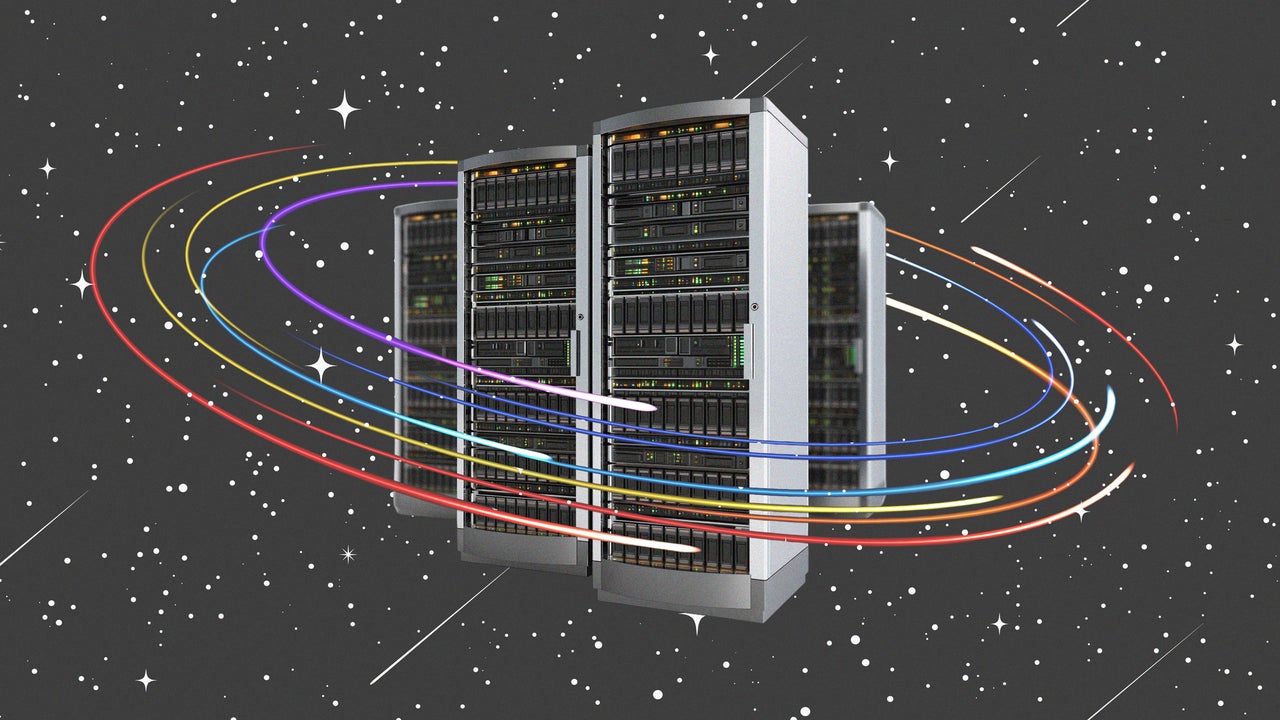
Why on earth do people want to put data centers in space?
It’s all about power and cooling. The chips that run AI models require a lot of electrical power, and our electrical grid will be seriously stretched to accommodate the wave of new AI data centers now being built or planned. Data centers, in fact, will account for almost half of U.S. electricity demand growth between now and 2030.
In space, there’s ample solar power for running AI servers. In the right orbit, solar energy is effectively continuous and more powerful than on Earth. Solar panels can collect about eight times as much energy in space as they can on Earth, and they need little battery storage.
That means no need for the terrestrial power grid, which will be challenged to accommodate the data center power demand of the future. The output of AI models running on the chips can then be beamed down to Earth by laser or radio. Proponents of orbiting data centers believe early test flights are the start of “solar-powered compute swarms.”
The orbital compute idea gained steam last year when Jeff Bezos said during a fireside chat in Italy that data centers “will be better built in space, because we have solar power there, 24/7.” The idea caught on within the investment community, as well as with a number of startups. The narrative continued to grow, leading Elon Musk to make space computing a leading ambition of SpaceX.
The idea also has plenty of critics, who argue that the economics remain daunting and that some of the supposed advantages of space, especially easier cooling, fall apart under closer scrutiny. But with major tech companies investing in orbital computing, and a growing crop of startups testing the technology, the push to find out whether it can actually work is only getting started.
Testing has begun
Last week, Google launched four of its homegrown Tensor processing units (TPUs) into orbit to test the in-space compute concept. The TPUs will orbit Earth aboard a solar-powered Planet Labs satellite. They were delivered into space on an uncrewed SpaceX Falcon 9 rocket on October 1. (Alphabet holds an $82 billion stake in SpaceX.)
The launch and chip testing are part of the Project Suncatcher initiative Google announced in November 2025. Ultimately, Google wants to run AI workloads on tight clusters of dozens of satellites linked by free-space lasers.
Starcloud has already flown an Nvidia H100 into space and is talking about assembling larger chip clusters and, eventually, multi-satellite constellations. The company’s CEO, Philip Johnston, has argued that hosting servers in space avoids delays and queues on the power grid; removes the need for water cooling, a key point in the political debate over data centers; and avoids fights over land rights.
“The lowest-cost place to put AI will be space,” Elon Musk said at Davos earlier this year, “and that will be true within two years, three at the latest.” In September Gwynne Shotwell, SpaceX president and COO, said the company aims to launch the first purpose-built orbital data center satellites in late 2027. SpaceX has filed with the Federal Communications Commission to launch up to a million satellites.
Nvidia has announced a space-grade Vera Rubin module, and Blue Origin has filed for a 51,600-satellite orbital data center network. Meanwhile, a handful of startups, led by Starcloud and Cowboy Space, are building small data center satellites that will run AI models for customers on the ground.
A lot to prove
Many industry experts say the economics of space-based data centers may not make sense for a long time, if ever. That’s partly because, despite the best efforts of SpaceX and Blue Origin, rocketing stuff into space is still very expensive, and payload capacities are constrained.
Skeptics, including engineers writing in IEEE Spectrum, World Economic Forum pieces, Brookings, and independent analyses, argue that even in space, cooling is a big problem. AI chips can run pretty hot, so a lot of heat must be carried away from them. Otherwise, they stop working or their lifespan shrinks. Space is very, very cold, so chips in orbit won’t heat up nearly as much, the thinking goes.
In Earth-based data centers, air and water do almost all the cooling. Fans and liquid loops quickly carry heat away from the chips. But because space is a vacuum, neither method works. Almost no air, and no water, can flow past the chips.
That leaves only radiation to dump heat into the surroundings, like the way an oven burner might transfer some heat to a hand held 2 feet above it. The satellite has to have big surfaces, called radiators, that get warm and shed the heat as infrared light. And those surfaces shed heat slowly compared with air or water cooling.
In Google’s “Suncatcher” tests, the Trillium TPU chips will run only short Gemini queries for limited stretches before shutting down to cool off.
A Saarland University paper called “Dirty Bits in Low-Earth Orbit” argues rocket launch and reentry emissions alone would cancel out any gains from getting data centers off Earth.
Space junk
Clutter and orbital debris could also impede the viability of chips in space. Adding tens or hundreds of thousands of new satellites raises the chance of collisions and resulting debris. Some critics worry this could lead to Kessler Syndrome, where low Earth orbit gets so crowded with satellites and debris that a single collision creates thousands of fragments that hit other objects and create more fragments, setting off a chain reaction. European Space Agency debris reports already show crowded LEO bands, with new low-orbit communication satellites mostly to blame.
At least one commentator has called the space-based data center idea harmful because it distracts investors from very real power bottlenecks for AI data centers and postpones tackling difficult questions about the limitations of terrestrial power.
Small experimental compute-in-orbit systems are real and flying, but the gigawatt-scale “data centers in space” concept remains a research bet with major economic, technical, and sustainability barriers to overcome.
Originally published by fastcompany.com. Syndicated material does not necessarily reflect the views of Cosmopolitan Canada.